loading
| SKU: | |
|---|---|
| Availability: | |


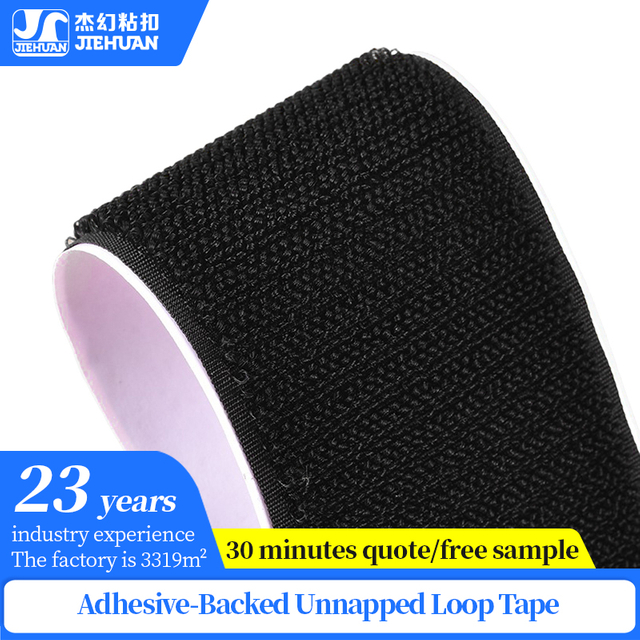
Adhesive-backed nylon loop fabric is a nylon loop face with a pressure-sensitive acrylic adhesive on the back and a release liner over it. It creates a loop field on a surface you cannot sew or weld — a machined housing, a coated panel, a wall or an existing product — and it can be applied in the field rather than in a press.
The acrylic system is measured at 4.5 ± 0.45 kg/in² of adhesive peel, with an initial tack of 5.3 ± 0.5 kg/in² and holding power above 4 psi for more than 12 hours. Those numbers describe a bond that carries a light-to-medium closure load on a sound surface. They do not describe a structural joint: if the loop has to take a peel load at the edge, a heat-sealed or stitched construction is the correct choice.
The adhesive is specified for 10 - 45 °C ambient application. Below that range tack drops sharply, so a cold warehouse is the wrong place to fit it. The surface must be clean, dry and free of oil, and firm roller pressure matters more than hand pressure — air pockets at the edge are where the lift starts.
| Item | Value |
| Adhesive type | Acrylic pressure-sensitive adhesive with release liner |
| Adhesive peel strength | 4.5 ± 0.45 kg/in² |
| Initial tack | 5.3 ± 0.5 kg/in² |
| Holding power | >4 psi for >12 hours |
| Application temperature | 10 - 45 °C ambient |
| Loop material | 100% nylon, or nylon-polyester |
| Shear strength | ≥11 N/cm² |
| Size and colour | 8 - 1500 mm to order; black, white, custom |
| Packaging | 25 meters per roll or 27.5 yards per roll |
Why does it lift off a plastic housing? Low-surface-energy plastics such as PP and PE, and powder-coated metal, bond weakly with a standard acrylic. Ask for a high-tack variant or a primer, and test on the actual housing rather than on a steel panel.
Can the loop field be removed later? Yes — that is the point of a pressure-sensitive product. Peel it back slowly and it releases with minimal residue, which is useful for demo units and retrofit kits.
When should I use the heat-sealed version instead? When the loop must survive washing, heat, or a peel load at the edge. The welded nylon loop fabric is permanent; this one is not.
Can it be die-cut to a shape? Yes. Pads and strips are cut through the liner so the part can be applied as one piece; send the drawing with the liner preference.
This is the version you reach for when there is no press, no needle and no time: peel the liner, press the loop field down, and the surface has a closure point.
Equipment already in service, panels already installed, walls that cannot be drilled — a self-adhesive loop field adds a mounting point without disassembly. Because the bond is removable, a mistake is recoverable, which matters when the work happens on site rather than in a factory.
Cable covers, battery doors, access panels and internal brackets take a die-cut loop pad where a screw boss would be too much work. Nothing penetrates the housing, so the enclosure's sealing is untouched.
Interchangeable printed panels, shelf talkers and exhibition graphics are re-hung many times. A loop field on the frame lets the panel be swapped without tools and without leaving adhesive on the graphic itself.
Cushion pads, headboard panels, acoustic tiles and removable covers use a loop field bonded to the substrate, so the hook side lives on the removable part. The fixed side stays flat and clean.
For a first build, an adhesive loop field lets a design be tested before anyone commits to a welding jig or a stitched seam. Production can then move to the heat-sealed version once the geometry is frozen.
Substrate material and surface finish (painted, powder-coated, bare plastic, glass)
Pad size and shape, and the liner you prefer for hand application
Load the closure will see, and whether it is peel or shear
Application temperature on the line, and whether parts are applied indoors
For the loop field that is welded instead of applied, compare heat-sealed nylon loop fabric; for hook-side adhesive pads see adhesive-backed PP molded hook.
VS Standard Polyester Hook & Loop:
300% better UV resistance (QUV accelerated test)
90% low-temperature tack retention (-30℃ verified)
48-Hour Rapid Prototyping (9 adhesive options tested free)
Global DDP Logistics (NA/EU/SEA/OC/SA/AF)
24/7 Engineer Support