
Views: 2 Author: Site Editor Publish Time: 2026-10-13 Origin: Site


You ask two suppliers for data on the same specification. One reports a peel strength of 3.2, the other 5.6. Which one is trustworthy?
Most of the time neither is wrong. The two reports were produced under different test methods or different test conditions. A test report is only meaningful together with the conditions it was measured under. Once you know which fields to check, you can tell instantly which numbers are comparable — and which have to be re-tested.
This guide covers three things: what the three core metrics actually measure, which condition fields on the report you must verify, and how to write requirements into a purchase specification.
Hook and loop fails in three distinct ways, and each has its own test. They are not interchangeable — using peel strength to judge load capacity is the single most common mistake.
Metric | Failure mode it describes | Test method | What to ask the supplier |
|---|---|---|---|
Shear strength | Both sides are pushed sideways; the hook and loop layers slip out of engagement | ASTM D5169, Shear Strength (Dynamic Method) of Hook and Loop Touch Fasteners | "Was shear tested by D5169 dynamic method? What was the specimen width?" |
Peel strength | The closure is pried open from an edge, separating point by point like tape | ASTM D5170, Peel Strength ("T" Method) of Hook and Loop Touch Fasteners | "Is it a T-peel? At what crosshead speed?" |
Cycle life | Grip decays after repeated opening and closing until it stops holding | Fatigue tester runs N open-close cycles, then remaining strength is measured | "How many cycles? What was the retention rate afterwards?" |
Shear represents in-plane loading: after the two faces are engaged, the sides are pulled apart parallel to the closure plane. Typical cases are a bundle of cables squeezed sideways or a strap pushed laterally on a machine.
D5169 is a dynamic method — the failure load is recorded as the material is loaded in a defined way, rather than by a slow static pull to separation. That makes shear data sensitive to loading rate and fixturing.
Peel represents an edge being lifted: one end of the specimen is folded into a T shape and the two legs are pulled apart, so the closure separates progressively from the edge. Typical cases are a panel being pried up or a wrist strap pulled open by a fingertip.
The T method yields an average force along the peel line (some labs also report peak values — confirm which one you are being given). Peel values are naturally much lower than shear values. They describe different physical events and should never be placed on the same scale.
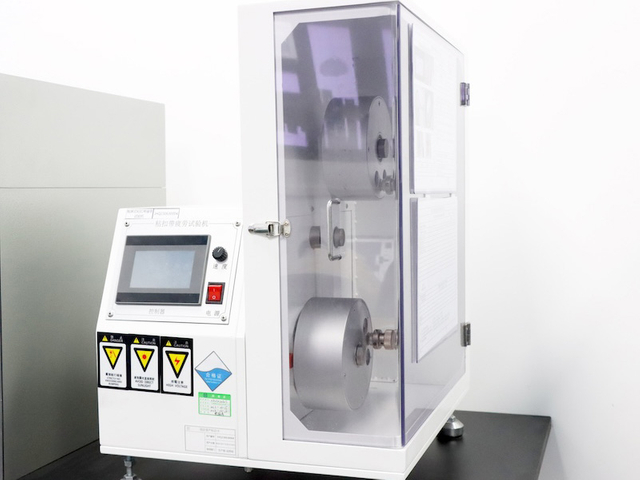
This measures durability: a fatigue tester opens and closes the closure a defined number of times (typically a few thousand up to tens of thousands), after which shear or peel strength is measured again.
The number that matters is not the absolute value after cycling — it is the retention rate (post-cycle strength ÷ initial strength). Within one batch, the material with the highest initial value does not necessarily have the best retention.

Before you read the result, verify these five fields. If any one of them differs, two reports cannot be compared directly.
Specimen width. Strength is normally normalized per unit width (N/cm, kgf/cm or lbf/in). Different width, different absolute value — and a report with no stated width is unusable for acceptance.
Overlap length. The engaged length. A longer overlap means more points participating in the peel, which changes the average force.
Crosshead speed. Different speed, different measured force. This is the most common single cause of mismatched numbers between two reports.
Conditioning temperature and humidity. Hook and loop — nylon in particular — absorbs moisture, and mechanical behaviour shifts with it. The report should state both the conditioning and the test environment.
Test direction. Along the tape length or across it, hook face up or loop face up — all of these affect the result.
A useful rule: a number plus its conditions is a complete datum. A number alone is an indication, not an acceptance criterion.
Three unit systems show up in practice: N/cm, kgf/cm and lbf/in. Roughly:
1 kgf/cm ≈ 9.81 N/cm
1 lbf/in ≈ 1.75 N/cm
When suppliers quote different units, convert first — otherwise the comparison is arithmetically meaningless.
Peak captures the hardest single point to separate and is useful for worst-case assessment.
Average describes overall engagement and is better suited to process control.
Scatter across specimens is often more informative than the average itself. A report that quotes a single figure with no specimen count tells you nothing about batch consistency.
For any application exposed to heat, humidity, UV or long service life — outdoor straps, automotive interior, medical wearables — initial values alone are not enough. Ask for:
data after constant temperature and humidity conditioning;
data after high-temperature, low-temperature or thermal shock cycling;
retention rates after UV or other ageing exposure.
These correspond directly to the test equipment involved: a constant temperature and humidity chamber, a thermal shock tester, and a UV ageing tester.
Specifying how something is to be measured matters far more than quoting an attractive number. Use this structure:
method + conditions + minimum + sampling, for example:
Shear: per ASTM D5169 dynamic method, specimen width ○○ mm, crosshead speed ○○ mm/min, 23±2 °C, average of 5 specimens ≥ ○○ N/cm;
Peel: per ASTM D5170 T method, same conditions, average ≥ ○○ N/cm;
Cycle life: after ○○ cycles, peel strength retention ≥ ○○%.
Three supporting practices:
Request itemized data and the original load-displacement curve, not just a summary figure. The curve is how you verify the test was actually run properly.
Agree the re-test rules up front — sampling ratio, what triggers additional testing when a first result fails, and who bears the cost of third-party re-testing.
For purchases in China, specify the Chinese national standard method. The product standard for hook and loop is GB/T 23315 (粘扣带), which covers both technical requirements and test methods. Writing "re-test per GB/T 23315" into the contract is more robust than agreeing on an isolated number.
One practical note: methods from different standard systems cannot be mixed. If one report follows ASTM and another follows a national standard, similar numbers still do not prove one material is better. Align the method first.
Treating peel strength as a load-bearing figure. Peel measures resistance to being pried open, not how much weight can be hung from the closure. For load-bearing applications, use shear, and account for overlap length and strap width.
Ignoring peel angle and crosshead speed. Comparing two "peel strength" numbers without checking conditions almost always leads to the wrong conclusion.
Looking only at initial values and skipping retention. Under heat, humidity and repeated cycling, good initial performance does not mean it will hold up in service.
A test report is one of the most direct pieces of evidence of a supplier's technical capability — it says as much about whether a factory takes testing seriously as it does about the product.
Jiehuan's in-house testing centre is equipped with a tensile strength tester, a hook and loop fatigue tester, a constant temperature and humidity chamber, a thermal shock tester, a UV ageing tester, an initial tack tester, a rubbing fastness tester, a colour difference tester, a standard light source cabinet and a quadratic optical measuring instrument, and can supply itemized test data on request. To evaluate shear, peel or durability performance for a specific specification, contact us.


