
Views: 4 Author: Site Editor Publish Time: 2026-09-08 Origin: Site


Walk into any fastener store and you will find the same roll of black hook and loop tape in three or four "versions" that all look identical at arm's length. Look closer and the differences are decisive: the way the tape is attached to your product determines assembly speed, durability, washability, temperature tolerance and total cost. Get the construction wrong and no amount of adhesive strength or cycle testing will save the application.
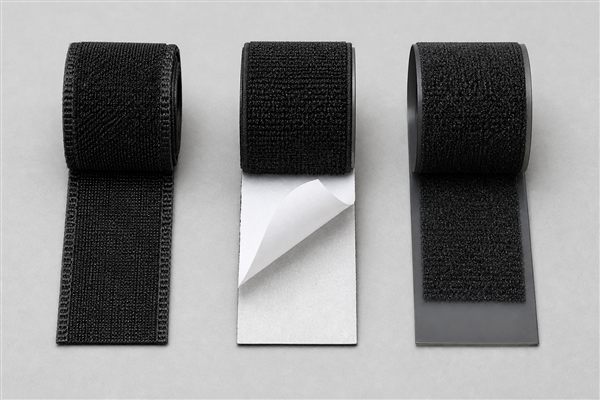
Illustrative scenario — not a customer project photo.
This guide compares the three mainstream attachment constructions — sewn, adhesive-backed (PSA) and heat-sealed — so engineers and purchasing teams can shortlist faster.
Sew-on hook and loop: the reliability benchmark
Sewn hook and loop is the original construction: the tape is stitched directly into the fabric or product.
Best for: garments, shoes, bags, upholstery, workwear, medical textiles and any application that will be washed, dry-cleaned or heavily stressed.
Strengths:
Highest mechanical anchoring — stitching physically locks the tape in place.
Excellent wash and dry-cleaning resistance (up to hundreds of laundry cycles when sewn with matching thread).
No adhesive failure mode, which matters at temperature extremes.
Repairable: if a stitch line fails, the tape can be re-sewn.
Limitations: adds a sewing operation to assembly; unsuitable for hard, non-textile surfaces like plastic housings or metal panels.
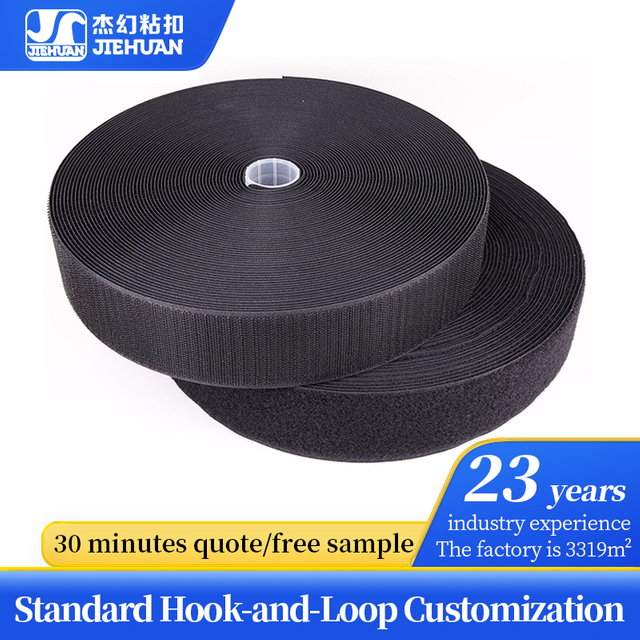
Sew-on hook-and-loop tape.
Adhesive-backed (PSA) hook and loop: speed on hard surfaces
Pressure-sensitive adhesive (PSA) tape carries a peel-and-stick adhesive layer protected by a release liner.
Best for: bonding to clean, smooth, non-porous surfaces — ABS and other plastics, coated wood, glass, film, aluminum and steel. Typical uses: wall-mounted organizers, electronics enclosures, signage, cable routing channels and temporary fixtures.
Strengths:
Fastest assembly: clean the surface, peel, stick. No tools, no curing.
Removable and repositionable options available for maintenance-friendly designs.
Works where sewing or heat is impossible.
Limitations:
Surface preparation is critical (degreasing improves bond life dramatically).
Adhesive performance is temperature- and solvent-dependent; check peel strength, initial tack and holding power specs before qualifying.
Not the first choice for constant heavy shear loads or frequent laundering.
Selection tips: match the adhesive to your substrate (many failures come from using a general-purpose adhesive on a low-surface-energy plastic), and validate with a peel-strength test on your actual production surface — not on a clean glass test panel.
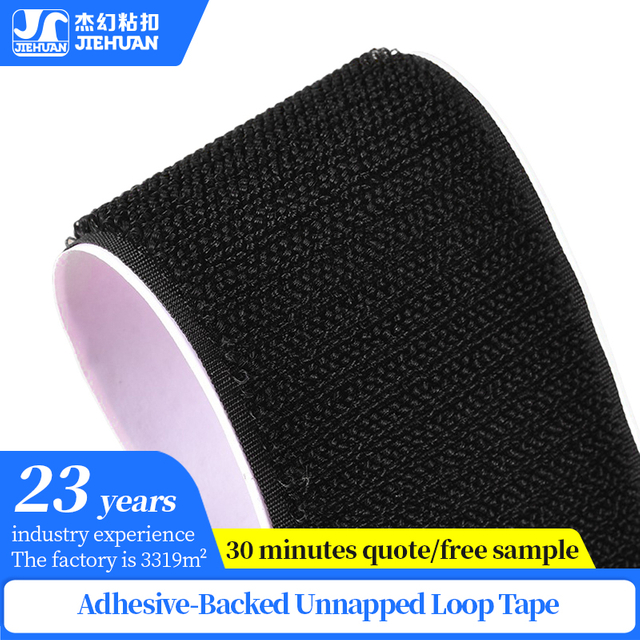
Adhesive-backed hook-and-loop tape with release liner.
Heat-sealed hook and loop: clean, fast, bonded without thread
Heat-activated hook and loop carries a thermoplastic hot-melt or reactive adhesive layer on the back that fuses to fabric or other compatible substrates under heat and pressure.
Best for: high-volume textile assembly where sewing is a bottleneck — heat-sealed unnapped loop fabrics for bedding and garments, hook and loop applied to shoe linings, performance wear, filter media, upholstery panels and products where a clean, thread-free back face is desired.
Strengths:
Strong, uniform bond across the full width — no stitch holes, no puckering.
Very fast cycle times once the heat press or roller line is set up.
Water-resistant seam character; can be engineered for lamination (e.g., polyurethane reactive laminated tape) for waterproof or airtight builds.
Lower consumables cost at scale compared with thread + sewing labor.
Limitations: requires heat/pressure equipment and substrate compatibility; not suited to hard plastic or metal surfaces (those should use PSA or molded solutions); bond quality depends on temperature and dwell-time process control.
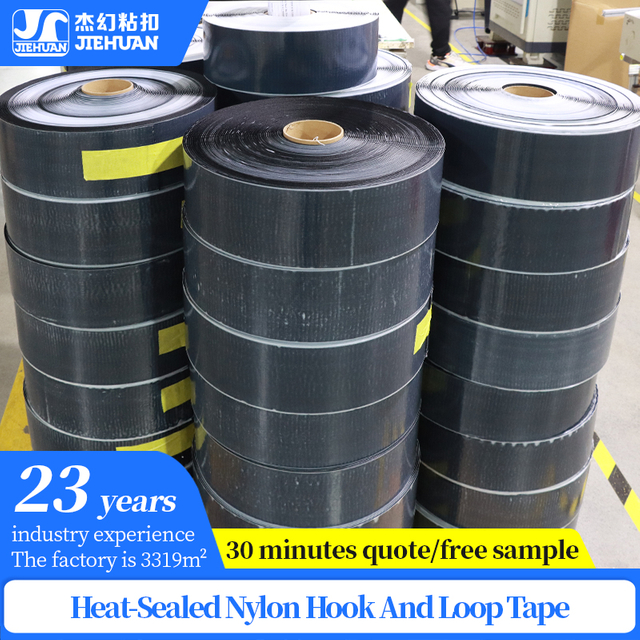
Heat-sealable hook-and-loop tape.
Molded hook: when strength and cycle life matter most
One construction deserves its own mention: injection-molded hook (nylon or polypropylene), which delivers consistent hook geometry and the highest open-close cycle life of any hook and loop family. Molded hooks are often paired with adhesive backing or sewn into products that open and close thousands of times — think cable management panels, display systems and reusable restraints. If your application cycles more than a few hundred times, molded hook should be on your shortlist.
Decision checklist
Washed / dry-cleaned textile product → Sew-on (or heat-sealed with verified wash resistance)
Bonding to plastic / metal / glass housing → Adhesive-backed (PSA)
High-volume textile assembly, clean back face → Heat-sealed
Thousands of open-close cycles → Molded hook
Waterproof / airtight laminate builds → Heat-sealed / PUR-laminated constructions
Ask your supplier three questions before sampling: (1) What substrate and surface energy do you expect us to bond to? (2) Will the product be washed, heated, or solvent-exposed in use? (3) How many open-close cycles does the end user actually need? The answers will point you to one construction — and to the right specification of width, color, adhesive and packaging.
Jiehuan Hook and Loop (Dongguan Jiehuan Electronic Technology Co., Ltd.) produces sewn-quality woven tapes, adhesive-backed, heat-sealed, back-to-back, molded and custom fastening systems with in-house width/color/adhesive customization, serving apparel, medical, electronics, automotive and home-industry customers worldwide.


