
Views: 1 Author: Site Editor Publish Time: 2026-10-29 Origin: Site


An adhesive-backed hook and loop strip lifts at the corner three days after installation, and the first conclusion is "bad glue". In most cases the adhesive did what it was designed to do — it just never got the three things pressure-sensitive adhesive needs: a clean high-energy surface, real pressure, and time.
Pressure-sensitive adhesive does not glue, it wets. It flows into the microscopic texture of the surface and holds by van der Waals forces. Low surface energy materials — PP, PE, powder-coated metal, silicone-contaminated plastics, dusty wood — resist that wetting, so the bond starts weak and creeps.
Wipe with IPA (70% isopropyl), not household cleaner. Let it flash off completely.
Do not touch the surface after wiping; skin oil is enough to halve the bond.
Freshly painted or powder-coated parts: wait for full cure, not just dry-to-touch.
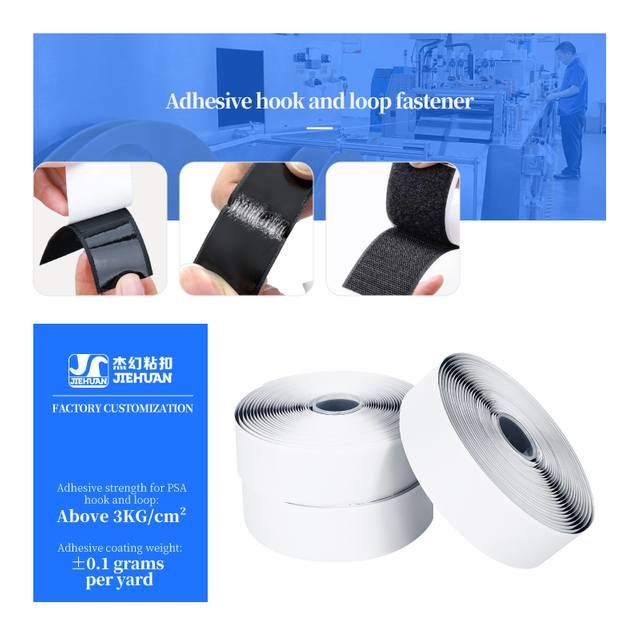
"Pressed it on firmly" usually means a few hundred grams per square centimetre. Adhesive datasheets assume 4–5 kg per square centimetre applied with a roller, two passes in perpendicular directions. On a 25 mm wide strip that is a deliberate, slow pass — not a thumb press. This single step explains most early failures on smooth metal.
Initial tack is maybe 20–30% of final bond strength. Full wet-out takes about 24 hours at 23°C, longer when cold. If the part is loaded, vibrated or washed in the first hour, the adhesive creeps and never recovers.
Condition at application | What happens | What to do |
|---|---|---|
Below 10°C | Adhesive too stiff to wet out; immediate peel | Warm part and tape to 20–30°C first |
Above 35°C or direct sun | Adhesive softens, slides under load | Apply in shade, hold with jig until cool |
Relative humidity above 70% | Moisture film blocks wetting | Dry the part, apply same day |
Curved surface, tight radius | Memory of the roll lifts the edge | Use thinner backing or pre-form; radius above 20 mm |
Peel always starts at an edge, and a square-cut edge sitting proud of the surface is the perfect lever. Two cheap fixes: inset the tape 2–3 mm from the edge of the part so nothing can catch it, or leave a small radius at the corners instead of a sharp 90°. On fabric that will be handled daily, a stitched or heat-sealed border removes the peel initiator entirely.
Before the batch ships, pull one part off after 24 hours and look at the residue: adhesive left evenly on both surfaces means the bond was right; adhesive all on one side means the surface lost. Then check the four corners with a fingernail — any lift means the edge geometry or the pressure step failed, not the material.
Choosing the right construction comes first: sew-on, adhesive-backed or heat-sealed. If the application is high temperature, read temperature limits before choosing an adhesive. For appliance and electronics builds, the adhesive-backed range lists the standard combinations.


