
Views: 2 Author: Site Editor Publish Time: 2026-10-19 Origin: Site


“Just quote me a spec” is the most common request a hook and loop supplier receives — and the most common reason a first sample fails. Four numbers decide whether a tape works: width, thickness, hook density and loop gram weight. They are not independent: making one bigger usually means paying for it somewhere else. This guide walks through how to set each one, and how to check them on incoming goods.
Peel and shear strength scale with the fastened area, not with width alone. A 25 mm tape fastened over 100 mm carries roughly the same load as a 50 mm tape fastened over 50 mm — the first is often cheaper and easier to sew.
Common stock widths: about 20, 25, 38, 50 and 100 mm. Wider rolls are available but cost rises faster than strength.
Rule of thumb: increase the length of engagement before increasing width. Width adds stiffness and cost; length usually costs nothing but a slightly longer seam.
Narrow tapes (20–25 mm) suit cable ties, cuffs and small wearables; 38–50 mm suits straps, bags and medical soft goods; 100 mm suits panel fixing and large-area bonding.
Thickness is the sum of backing plus hook or loop pile. It changes how the closure looks and feels more than how strong it is.
Low-profile (thin backing, short hooks) — for garments, wearables and anywhere the closure must disappear under fabric.
Standard — the default for straps, bags and general industrial use.
High-pile / cushioned — for seating, helmets and parts that need to absorb vibration or fill a gap.
Hook height also affects engagement depth: taller hooks grab more loop fibre and hold better on thick, brushed or non-woven loops, but they are noisier to open and feel rougher.
This is where most specifications are lost, because neither number is printed on the roll.
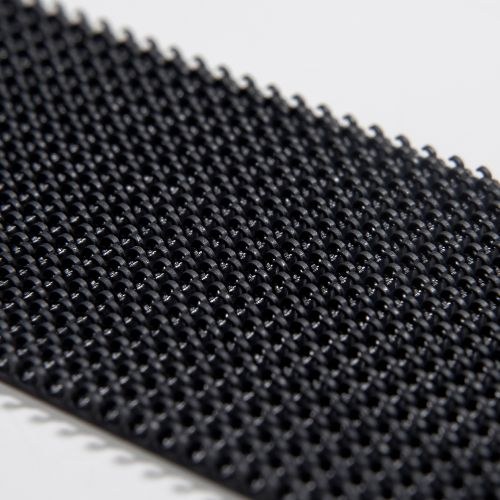
Hook density (hooks per unit area) — more hooks per cm² means more engagement points, higher peel and shear, and slower clogging with lint. It also means a stiffer, more expensive tape.
Loop gram weight (g/m²) — the weight of the loop fabric. Heavier loop means more fibre for the hooks to grab, better cycle life and less matting after repeated opening. Light loop is cheaper and thinner.
For a given width, loop gram weight is usually the single biggest lever on cycle life; hook density is the biggest lever on initial peel.
Acceptance tip: weigh a known area (e.g. a 100 × 100 mm coupon) to verify loop gram weight, and count hooks over a fixed window under a loupe to verify density. Both are cheap incoming checks that catch most substitution.
Application | Width | Hook type | Loop weight |
|---|---|---|---|
Cable tie / cord wrap | 20–25 mm | Standard or molded | Light |
Cuff / garment closure | 20–38 mm | Low-profile | Light–medium |
Bag, strap, general industrial | 38–50 mm | Standard | Medium |
Medical soft goods / wearable | 25–50 mm | Low-profile, soft edge | Medium, skin-friendly |
Panel fixing / large area | 50–100 mm | Standard or high-density | Medium–heavy |
Seating / cushion / helmet | 25–50 mm | High-pile friendly | Heavy |
Width tolerance — measure at three points per roll; slitting drift is common.
Loop gram weight — weigh a fixed coupon as above.
Peel strength — pull a standard coupon per your own or the supplier’s test method; see how to read a hook and loop test report.
Hook density (visual) — count hooks in a fixed window; compare against the approved sample.
“Wider is better.” Wider adds cost and stiffness; longer engagement usually wins.
Buying on price per metre only. A lighter loop at the same width can halve cycle life — the cost per closure, not per metre, is what matters.
Ignoring the loop. Most failures are loop-side failures (matting, fibre pull-out), not hook-side.
Once the four numbers are set, pick the base material: 100% nylon hook and loop tape for the widest temperature and cycle window, black-and-white nylon tape for two-tone assemblies, adhesive-backed tape for smooth rigid surfaces, and heat-sealed tape for thermoplastic substrates. For cable ties and straps, see back-to-back hook and loop tape.
Tell us the load, the substrate and the number of open/close cycles, and we will propose width, hook type and loop weight for your application.


