
Views: 3 Author: Site Editor Publish Time: 2026-11-24 Origin: Site


On 19 November 2026, ECHA's Committee for Socio-Economic Analysis (SEAC) adopted its final opinions on the restriction proposals for PFAS and for certain chromium(VI) substances. The Risk Assessment Committee (RAC) had already adopted its final opinions on the same proposals earlier in the year. With SEAC's adoption, the scientific evaluation stage at ECHA is closed.
For anyone selling into Europe, the practical meaning is narrow but real. The open question is no longer whether the EU will act on PFAS as a group. It is how the derogations and transition periods will be written, and which applications will have to change first.
ECHA's own wording is worth reading closely. SEAC supports an EU-wide restriction of PFAS, in the form of a ban with use-specific derogations. It also supports transition and derogation periods, including time-limited derogations for certain sectors while alternatives are assessed. On additional risk management measures, SEAC says it supports them in principle but that the information provided was not sufficient to assess costs and benefits properly.
None of that is law. The opinions will be finalised in the coming weeks and sent, together with the RAC opinions and the background documents, to the European Commission. The Commission then prepares a restriction proposal, which is discussed and voted on in the REACH Committee by the Member States. Only after that does a restriction enter the legal text, with its own application dates and its own list of derogations.
So no PFAS ban applies to your product today because of this opinion. If a customer tells you "PFAS is banned from January", that is not what the 19 November decision says.
These are two different instruments, and mixing them up causes real problems in quotations.
The PFHxA restriction is a single substance group with concentration limits in the parts-per-billion range, and it has applied since 10 October 2026. The universal PFAS proposal covers the whole group, and it is still in the legislative process. Complying with PFHxA does not make a product "PFAS-free", and a PFAS declaration does not replace a PFHxA statement. European buyers are increasingly asking for both documents, in the same email.
Standard nylon and polyester hook and loop tape does not normally contain intentionally added PFAS. The risk rarely comes from the hook and loop yarn itself. It comes from what is added around it:
Repellent finishes. Water-, oil- or stain-repellent treatment applied to the loop side for outdoor, medical or automotive use.
Adhesives and primers. Some pressure-sensitive adhesive systems, and the primers used to make them stick to low-energy surfaces.
Release liners. Certain coated papers and films used behind adhesive-backed tape.
Auxiliaries in specialty variants. Flame retardants, antistatic treatments and similar additives.
That list is the reason a one-line "our tape is PFAS-free" statement is not enough. A usable declaration follows the bill of materials, homogeneous material by homogeneous material, and names which of the above are present or absent.
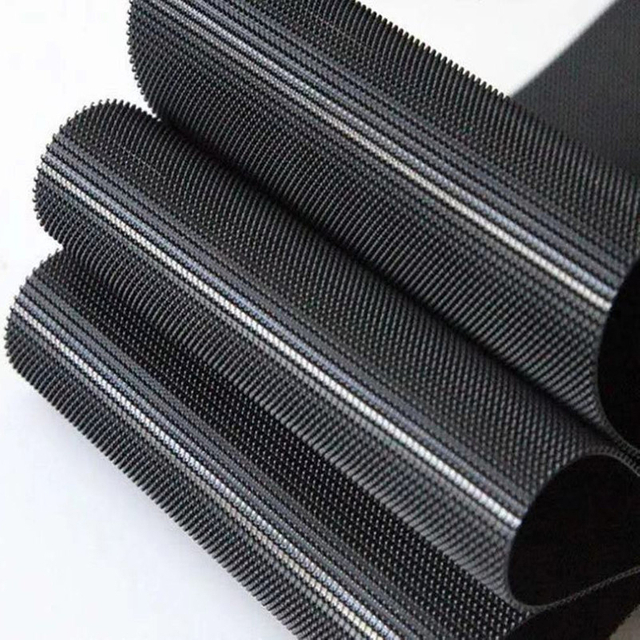
Hook and loop tape rolls showing the hook side construction.
1. Split the bill of materials by homogeneous material. A strap is not one material. Hook tape, loop tape, adhesive, primer, liner, and any coating are separate entries, and each needs its own answer.
2. Ask for declarations that name PFAS as a group, not only PFHxA. A supplier questionnaire written in 2024 will usually list PFHxA, PFOS and PFOA. That wording now under-answers the question. Add a line asking about the full PFAS group, and ask what test method and detection limit were used.
3. Start with the repellent finish and the liner. Those two are where substitution work takes longest. Non-fluorinated durable water repellents exist, but they change hand feel, appearance and cost, and the qualification cycle runs for months. Starting in 2027 means shipping whatever is available; starting now means choosing.

Heat press used for heat-activated hook and loop assembly.
When the Commission publishes its proposal, we will update this article with the parts that affect hook and loop specifically: which applications are proposed for derogation, the transition lengths, and the declaration format buyers are likely to demand.
If you are preparing a PFAS questionnaire for a European customer and want a material breakdown for a specific item, send us the part number and the intended application. We will answer on the material level rather than with a general statement.


