
Views: 2 Author: Site Editor Publish Time: 2026-11-23 Origin: Site


If you sell hook and loop tape, adhesive-backed fasteners or cable straps to a French apparel, footwear or household-linen brand, your inbox will get a specific request within the next few days. It will not be about peel strength.
France's textile extended producer responsibility (EPR) scheme is run by Refashion and has been operating since 2007. Its 2026 eco-modulation cycle has a documentation deadline of 30 November 2026 — the date by which a producer registers bonus evidence for the 2026 reference year. That request lands on the supplier, because the producer cannot file numbers it does not have.
This article is a supplier-side briefing: what the deadline actually requires, where a fastener supplier sits in the chain, and the four documents you should be able to send the same day.
Four dates matter, and they are frequently quoted in the wrong sequence.
Date | What happens |
|---|---|
Before 30 November 2026 | Register 2026 bonus evidence. Registering by this date keeps correction access open through 31 December. |
1–31 December 2026 | Registration is still possible, but with no later correction. |
By 12 January 2027 | Deadline to register 2026 penalty references. |
13 January – 28 February 2027 | Declare own-activity 2026 quantities placed on market for the 2027 campaign. Marketplace declarations run 15–25 March; payment runs 13 January – 31 March 2027. |
So the practical answer to "when do I need my data ready" is: before 30 November, not before the end of the year. The difference between filing on 29 November and 3 December is whether you can still fix a mistake.
The obligation sits with the producer — the company that places the finished garment, shoe or household linen on the French market. A hook and loop tape manufacturer is a component supplier, not a producer under the scheme.
Three consequences worth stating plainly:
You are not the declarant. Your customer is. Do not tell buyers "we are EPR compliant" — it is the wrong claim and a compliance team will spot it.
Your data still decides their number. Bonus eligibility is assessed on the finished product, but the inputs — fibre type, recycled content, durability test results, labelling — are supplied up the chain.
Scope is narrower than "textiles". The French TLC stream covers consumer clothing, footwear and household linen. Workwear and professional products have to be checked individually rather than assumed in or out.
The legal basis is Article L.541-10-1(11) of the Environment Code, Law 2026-602 of 8 July 2026, and the Order of 23 November 2022 as amended by the Order of 20 October 2026 (NOR TECP2627746A), published 21 October and in force 22 October 2026.
Eco-modulation moves the fee up or down. On the bonus side, the categories that matter to a fastening supplier are durability, specified finished-product labelling, and eligible recycled inputs.
On the penalty side, a commercial-practice penalty applies to listed apparel where the product's D score is at or below 0.8 — the ultra-fast-fashion threshold. The published range for 2026–2027 is €0.50 to €12 per item, and a penalised product cannot also receive bonuses. That combination is the part buyers get wrong: it is not a fee you offset, it is a fee that closes the bonus door.
For scale, the 2027 ordinary schedule runs from €0.0209 to €0.2393 per declared item depending on category, with a simplified schedule for producers under 5,000 pieces a year (apparel €0.6378, household linen €0.7179, footwear €0.7056 per piece), plus a €30 administration charge and an ADEME levy whose 2027 amount had not yet been specified at the time of writing.
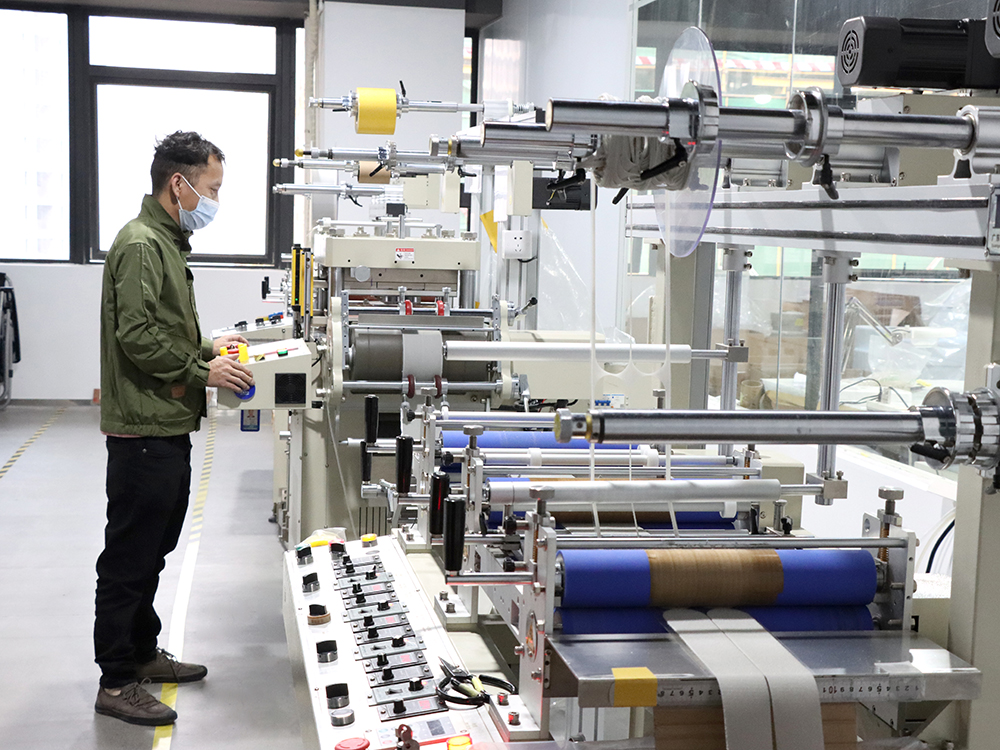
Die-cutting line producing adhesive-backed hook and loop rolls at the Jiehuan factory.
These are the four that recur in every supplier request we see. All four are things a fastener manufacturer already produces; the problem is that they are scattered across production, QC and sales instead of being one folder.
1. Fibre composition and weight per unit area.
Resin type (nylon 6, nylon 6.6, polyester, polypropylene), hook versus loop, and g/m² for the tape. This is the base record. If your customer's garment contains both nylon and polyester tape in different positions, give them separately — a blended figure is not usable.
2. Recycled content evidence, tied to the lot.
A certificate is not enough on its own. What gets accepted is a chain-of-custody document that links the certified claim to the specific delivery. If you hold RCS or GRS certification, supply the transaction certificate for that shipment, and state the percentage rather than "recycled".
3. Durability test reports.
Peel strength, shear strength and wash-cycle retention. Durability is a bonus criterion on the finished product, so a brand needs the number and the method behind it. Report the standard, the specimen width, the number of cycles, and the condition after testing — a bare "peel strength 3.2 N/cm" tells a compliance team nothing it can file.
4. Packaging and labelling information.
Roll core material, liner, bag and carton specification, plus whatever marking you apply. This feeds the recyclability side and the finished-product label requirement. State clearly whether the roll core is paper or plastic — it changes the packaging declaration.

UV ageing test chamber used to verify material durability before a lot ships.
Sending a certificate instead of data. A scanned ISO 9001 certificate answers a factory audit question, not a material question. EPR filings need composition, percentages and test methods.
Quoting a range with no method. "Peel strength 2.5–4.0 N/cm" without a standard reference cannot be filed and will be sent back.
Treating the four documents as one annual PDF. Dates drift. Recycled-content transaction certificates are lot-specific, and test reports expire against the buyer's own validity rule. A single undated pack invites rework in November.
Assuming the brand has your spec sheet. Often the brand's compliance manager has the purchase order and the invoice, and nothing technical. Restating the basics costs you ten minutes and saves a week.
Copy this into your quotation template so it stops being a November scramble:
☐ Resin type for hook and for loop, stated separately
☐ Weight per unit area, g/m²
☐ Width and thickness with tolerance
☐ Recycled content percentage, plus transaction certificate number for the specific lot
☐ Peel strength: value, standard, specimen width
☐ Shear strength: value, standard, specimen geometry
☐ Wash retention: cycles, temperature, residual performance
☐ Roll core material, liner type, packaging specification
☐ Document issue date and next review date
You cannot file for your customer, and you should not imply that you can. What you can do is make the four documents routine: issue them with every quotation, keep them versioned, and refresh them when a lot changes.
That is also the commercial argument. Every French brand in scope is currently chasing the same data from the same suppliers. A supplier that answers in one email with method-level detail gets asked again next season — and gets the specification written around its capability.
Sources
France textile EPR country dossier (research baseline 6 October 2026, selected verification 16 November 2026): https://eprtextile.com/countries/france/
Refashion — eco-modulation evidence and campaign timetable: https://pro.refashion.fr/metteur-en-marche/les-eco-modulations
Refashion — 2027 eco-contribution guide (official PDF): https://media-pro.refashion.fr/2026/11/refashion_guideecocontribution_2027_fr_vf.pdf
Refashion — 2027 tariff annex and simplified schedule (official PDF): https://media-pro.refashion.fr/2026/11/guideecocontribution_2027_fr_annexes_6-11_sans_annexe_i_ii.pdf
ADEME — ultra-fast-fashion penalty: legal effect and implementation: https://filieres-rep.ademe.fr/actualites/textile-lultra-fast-fashion-penalisee
France — final Order of 20 October 2026 on the commercial-practice penalty: https://www.legifrance.gouv.fr/jorf/id/JORFTEXT000055002495
Fee amounts and dates are quoted from the Refashion and ADEME publications above; confirm against the current official page before relying on them for a filing.


