Views: 203 Author: Damon Publish Time: 2025-07-01 Origin: Site


Content Menu
● Exploring Hook and Loop Fasteners: Definition, Working Principle, and Applications
>> What are Hook and Loop Fasteners?
>> Unveiling the Working Principle
>> Key Performance Indicators and Industry Terminology
>> JieHuan's Quality and Innovation
Hook and Loop Fasteners, commonly known to the public as "Velcro" (a brand name often used generically), are an innovative and reusable mechanical fastening system. With their unique simplicity and versatility, they have become an indispensable fastening solution in various sectors, from everyday consumer goods to high-tech industries.
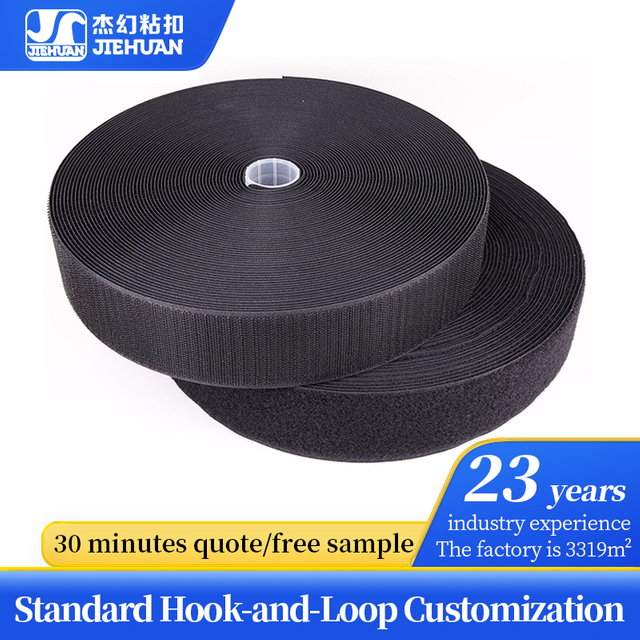
A hook and loop fastener is a two-part fabric strip designed to create temporary or semi-permanent connections through physical engagement. Its core lies in two key components:
Hook Side: This part typically consists of a dense array of tiny "hooks." These hooks are usually made from synthetic polymers such as Nylon or Polyester, possessing a certain degree of rigidity and elasticity. The hooks are designed in various shapes, commonly including J-hooks, mushroom-shaped hooks, and bent hooks, aimed at optimizing their gripping power and durability.
Loop Side: This part is composed of countless soft "loops" or "circles," also made from materials like Nylon, Polyester, or Polypropylene. These loops are typically uncut yarn loops that allow the hooks to embed and get trapped within them.
When these two fabric strips are pressed together, the hooks penetrate and engage with the loops, forming thousands of tiny mechanical connection points, which generate a secure Adhesion Strength.

The bonding principle of hook and loop fasteners is based on simple mechanical physics. When the hook and loop sides come into contact and pressure is applied:
Engagement: The hooks penetrate the surface of the loop side and interlace with the fibrous loops inside.
Locking: Due to the shape of the hooks and the elasticity of the materials, they "lock" onto the loops, creating a physical barrier that resists separation.
Peeling and Shearing: When a user wishes to separate the two parts, by applying a Peel Force (perpendicular to the plane) or a Shear Force (parallel to the plane), the hooks gradually disengage from the loops. Repeatability is a key advantage; high-quality hook and loop fasteners can withstand thousands of Cycle Life without significant performance degradation.
When evaluating the performance of hook and loop fasteners, the industry focuses on several important technical parameters:
| Performance Metric | Definition | Common Units | Influencing Factors |
| Peel Strength | The force required to separate the hook and loop sides perpendicularly. Higher indicates stronger bond. | lbs/inch or N/cm | Hook shape, density; loop density, height |
| Shear Strength | The force required to slide the hook and loop sides apart in a planar direction. Higher indicates stronger bond. | lbs/sq inch or Pascals (Pa) | Contact area between hook and loop, material friction coefficient |
| Cycle Life | The number of times the hook and loop can be opened and closed before significant performance degradation (usually 50% drop in peel strength). | Cycles | Hook and loop material, structure, manufacturing process |
| Operating Temperature Range | The temperature range within which the product functions normally. | Celsius (°C) or Fahrenheit (°F) | Material type (e.g., Nylon is less heat resistant than Polyester) |
| Flame Retardancy Rating | The material's ability to resist combustion, often classified by UL94 standards. | UL94 V-0, V-1, V-2 | Material formulation, coating |
| Adhesive Type | The type of adhesive used to attach the hook and loop fastener to other surfaces. | Rubber-based, Acrylic-based, Hot-melt | Application environment (temperature, humidity, surface) |
For example, a typical industrial-grade hook and loop fastener might exhibit the following performance: Peel Strength ≥ 1.5 lbs/inch, Shear Strength ≥ 10.0 lbs/sq inch, Cycle Life ≥ 3,000 cycles.

Hook and loop fasteners are widely used due to their convenience, adjustability, and durability in:
Apparel and Footwear: Replacing buttons and zippers for easy donning and doffing, such as in children's clothing and athletic shoes.
Healthcare: Securing bandages, braces, orthotics, and medical devices, providing adjustable support and ease of application.
Automotive and Aerospace: Used for interior trim, wire harness management, and component fastening, offering lightweight and convenient solutions.
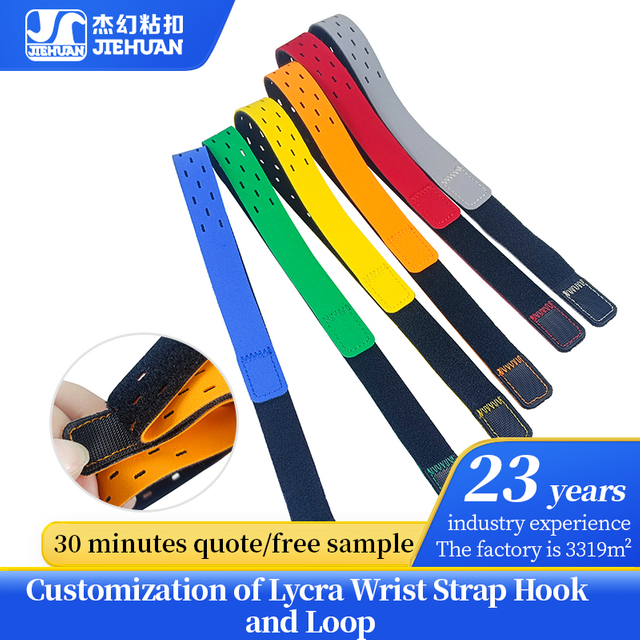
Industrial and Electronics: Cable management (e.g., Wire Straps), tool securing, and equipment component installation.
Military and Outdoor: Tactical gear, backpacks, tents, providing quick and reliable fastening.

As a specialized supplier of hook and loop fasteners, JieHuan is dedicated to providing high-quality, high-performance products. We deeply understand industry needs and strive for excellence in material selection, manufacturing processes, and quality control. JieHuan products not only comply with stringent international standards but also offer Customized Solutions to meet specific client requirements, including special sizes, colors, adhesive types, and properties like high-temperature resistance or flame retardancy. This ensures our hook and loop fasteners perfectly integrate into your product designs, enhancing both functionality and user experience.