
Views: 8 Author: Site Editor Publish Time: 2026-09-10 Origin: Site


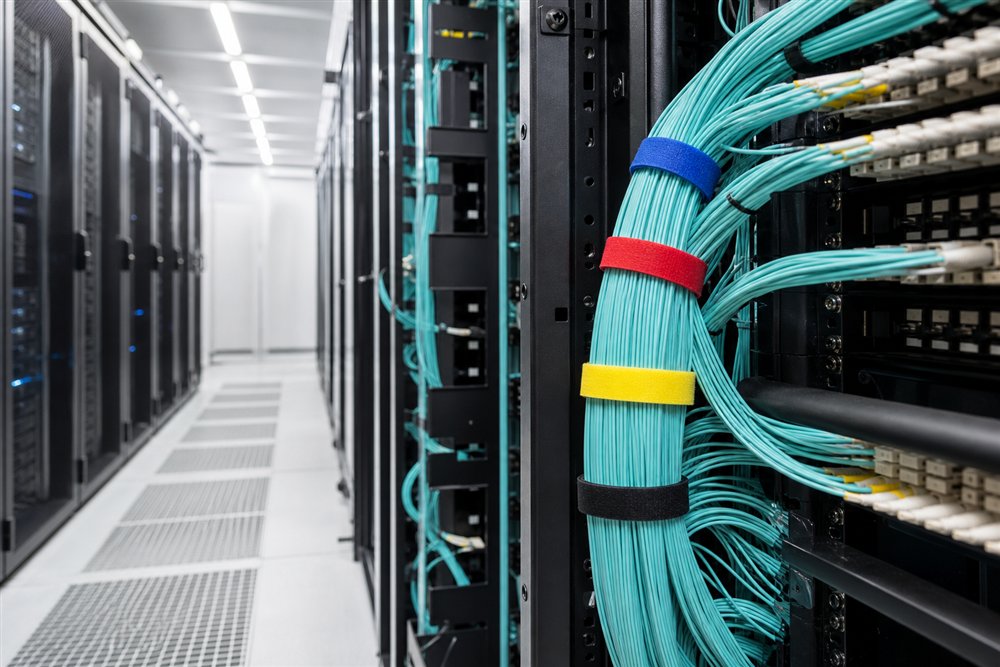
Data center growth is often discussed in terms of power, cooling and land. Fiber access is now joining that list of constraints.
In a September 3, 2026 analysis, Data Center Knowledge reported that enterprise-grade fiber capacity and route diversity increasingly affect where data centers can be built and how quickly they can scale. The article cited a 2025 bandwidth report showing that bandwidth purchased by data centers grew by roughly 330% in the early 2020s, driven partly by data-intensive workloads such as real-time AI inference.
More fiber capacity also means more physical connections to route, identify, inspect and change. Operators may need multiple carrier paths, frequent expansion work and clearer separation between power, network and optical-fiber runs. This does not make a cable tie the solution to a fiber-capacity shortage. It does make the quality of day-to-day cable management more important.
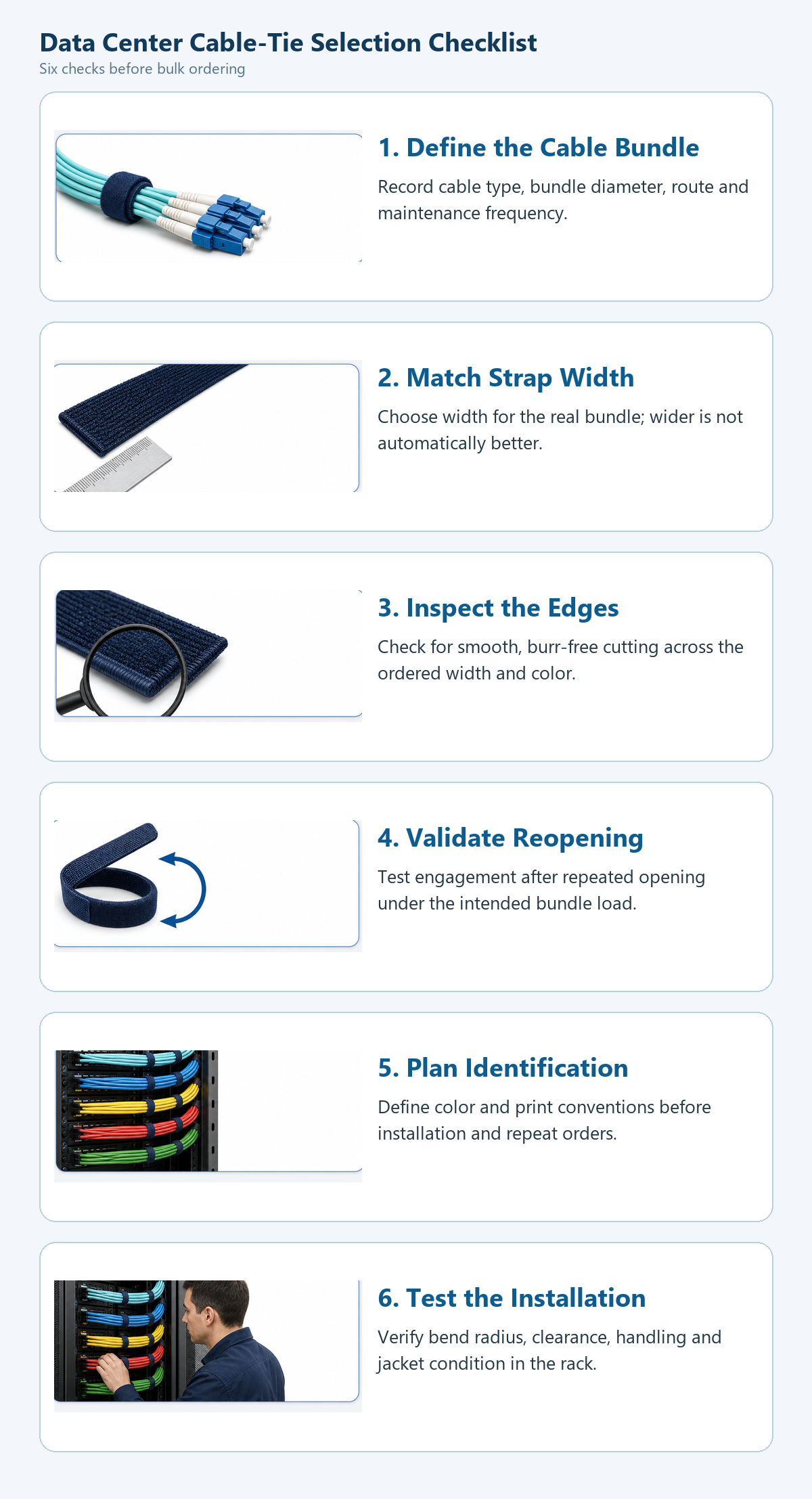
For dense racks and frequently maintained pathways, a reclosable hook-and-loop tie can be more practical than a single-use fastener. The right choice, however, depends on the cable bundle, installation method and documented material performance. The following checklist helps buyers evaluate the fit.
Record the cable type, bundle diameter, routing path and maintenance frequency before choosing a strap. Optical-fiber jumpers require particular attention to bend radius and localized pressure. A tie should organize the bundle without forcing a tighter bend or creating an excessive pinch point.
Do not rely on a generic statement such as “fiber safe.” Validate the proposed tie on the actual cable type and bundle configuration used in the rack.
A wider strap distributes fastening force over a larger surface, while a narrow strap may be easier to route through compact equipment. Neither is automatically better.
Jiehuan’s current AI computer-room hook-and-loop strap record includes regular widths of 10, 12.5, 14.5, 20 and 25 mm, with custom widths available. These options provide a starting point, but final selection should be confirmed through a sample test on the intended bundle.
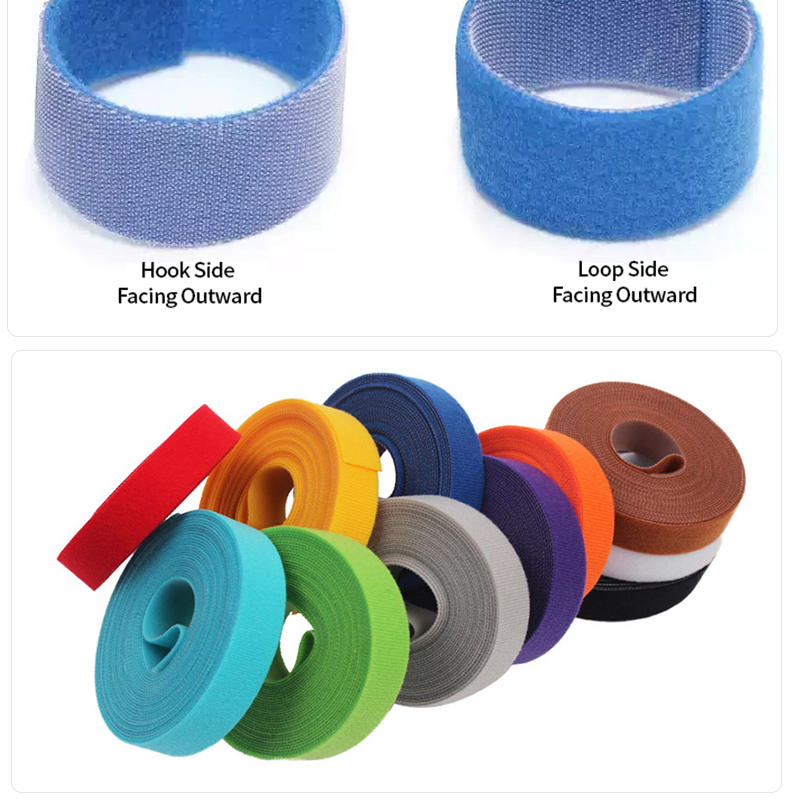
Data center technicians repeatedly reach into racks, trays and cabinets. Rough or stiff strap edges can inconvenience operators and may contact cable jackets during installation.
Look for a smooth, burr-free edge and consistent cutting quality. Jiehuan’s AI computer-room strap uses ultrasonic hot-cut edge processing. Buyers should still inspect production samples and confirm that the edge finish remains consistent across the required width and color.
High-density infrastructure is not static. New modules are installed, carriers are added and routes are reorganized. A reclosable strap should retain useful engagement after repeated opening and closing.
The current Jiehuan product record specifies more than 10,000 opening-and-closing cycles and a hook-to-loop engagement rate of at least 95%. These figures should be reviewed together with the buyer’s own maintenance frequency, bundle load and acceptance method rather than treated as a universal guarantee for every installation.
Compliance requirements vary by facility, country and component location. Buyers may need information on flame retardancy, restricted substances, material composition, temperature range and labeling.
Jiehuan’s AI computer-room strap record specifies a halogen-free flame-retardant nylon construction, UL94 V-0, an operating range from -30°C to 80°C, and RoHS and REACH documentation. Before approving production, confirm the applicable test report, sample construction and scope of each document for the exact configuration being purchased.
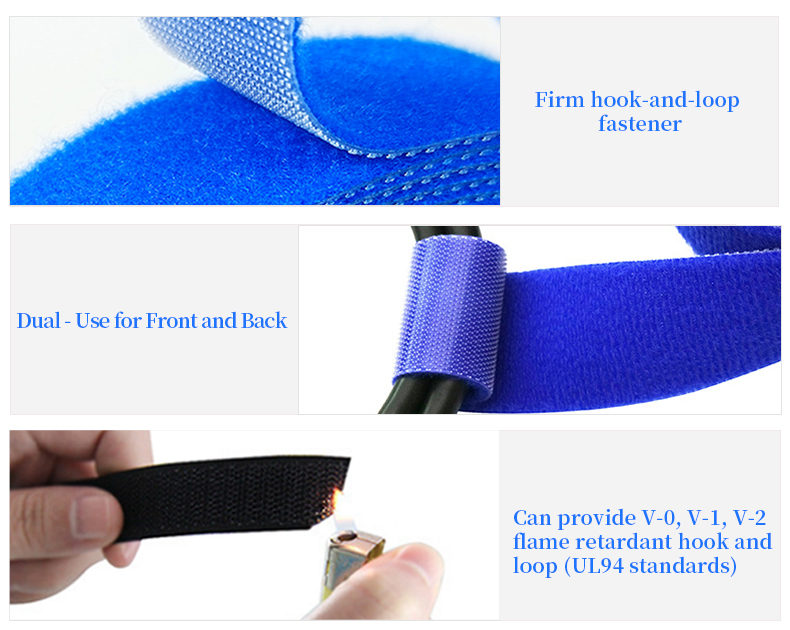
Color coding and printed identification can reduce confusion during maintenance. Different colors may be assigned to power, network and optical-fiber groups, while printed text can identify routes, cabinets or ownership.
Jiehuan lists black, white, gray, red, yellow, blue and green as standard color options for this product record, with custom colors and fixed-length cutting available. A buyer should define the identification convention early so that color, printing and packaging remain consistent across batches.
A product data sheet cannot replace a real application trial. Before bulk ordering:
build the intended cable bundle;
confirm bend radius and routing clearance;
test installation and removal by the people who will maintain the system;
inspect cable jackets after repeated adjustments;
verify that the strap length leaves sufficient engagement without excess material;
confirm that labels and colors remain readable in the actual rack environment.
The objective is not simply to achieve a strong closure. It is to create a fastening method that supports orderly routing and repeatable maintenance without introducing a new constraint.
Fiber constraints are increasing the value of careful capacity and route planning. Inside the facility, maintainable physical organization supports that planning by making changes easier to execute and verify.
Hook-and-loop cable ties are a small component, but their width, edge finish, reopening performance, documentation and identification options deserve the same disciplined review applied to other infrastructure parts.
Jiehuan supplies customizable hook-and-loop cable straps for AI computer rooms, server racks and cable-management applications. To evaluate a suitable configuration, send us your cable type, bundle diameter, required width and length, operating environment, documentation requirements and expected order quantity. We can prepare a sample specification for application testing before production approval.
Christopher Tozzi, “Could Fiber Be the Next Big Bottleneck in Data Center Growth?”, Data Center Knowledge, September 3, 2026: https://www.datacenterknowledge.com/networking/could-fiber-be-the-next-big-bottleneck-in-data-center-growth-


