
Views: 5 Author: Site Editor Publish Time: 2026-11-12 Origin: Site


For most of the hook and loop industry, the hook face has been judged by two numbers: peel strength and shear strength. That is still true for a cable tie or a wall mount. It stops being true when the fastener touches skin.
At China International Import Expo 2026, 3M introduced a premium hook face positioned on softness and hand-feel alongside holding performance, aimed at applications where touch matters. Whatever one thinks of a single launch, it marks a shift worth noting: buyers of wearable and body-contact products are now writing comfort into the purchase specification, not treating it as a nice-to-have.
That creates a practical problem. "Soft" is not a number. If it stays in the specification as an adjective, two suppliers can both agree to it and deliver products that feel completely different. This article is about turning that adjective into something a supplier can measure and a buyer can accept or reject.
Softness in a hook face comes from three structural decisions, and each one has a consequence for holding.
Filament diameter. Thinner monofilament bends more easily against the skin. It also carries less load per hook, so engagement strength drops unless hook count rises to compensate.
Hook density. More hooks per square centimetre raise engagement, but also raise stiffness and cost. Density is the main lever a supplier uses to recover the strength lost by going thinner.
Base fabric and coating. A thinner, more flexible backing improves drape and reduces the hard edge a wearer feels. But a thin backing curls more during sewing and can distort under tension. Heavier coatings stiffen the hand.
The result is not a linear trade-off. A well-built soft hook can hold as well as a standard hook at the same width, because the supplier has raised density to compensate. A cheap soft hook simply reduces filament diameter and lets holding fall. Both are sold as "soft".
Peel and shear are reported on nearly every datasheet. Two properties that matter just as much for wearables usually are not.
Engagement consistency at low pressure. A wearer closes a wrist strap with thumb and forefinger, not with a roller. A stiff hook that engages beautifully under 2 kg of roller load may only partly engage under finger pressure, and partial engagement is what causes a strap to slip during movement.
Edge comfort. The cut edge of the hook tape is where irritation usually starts, not the face. A soft face on a sharp die-cut edge still scratches. Edge treatment, radius and backing thickness decide whether the part is wearable for an hour or for a shift.
Type | Hand-feel | Holding | Typical use |
|---|---|---|---|
Standard single hook | Firm, noticeable texture | High per unit area | Outer straps, equipment, non-contact zones |
Fine / soft hook | Soft, low texture under finger | Moderate, depends on density | Wrist bands, apparel closures, body-contact straps |
Mushroom (molded) hook | Flat, smooth surface | High, resistant to lint | Repeated open-close, automotive trim, thicker assemblies |
Two notes. A mushroom head is smooth to the touch but is not soft in the bending sense: it is a molded stem on a heavier backing, so it suits repeated cycles more than skin contact. And a fine hook paired with a standard loop can feel harsher than the same hook on a soft loop, because loop construction contributes as much to hand-feel as the hook does.
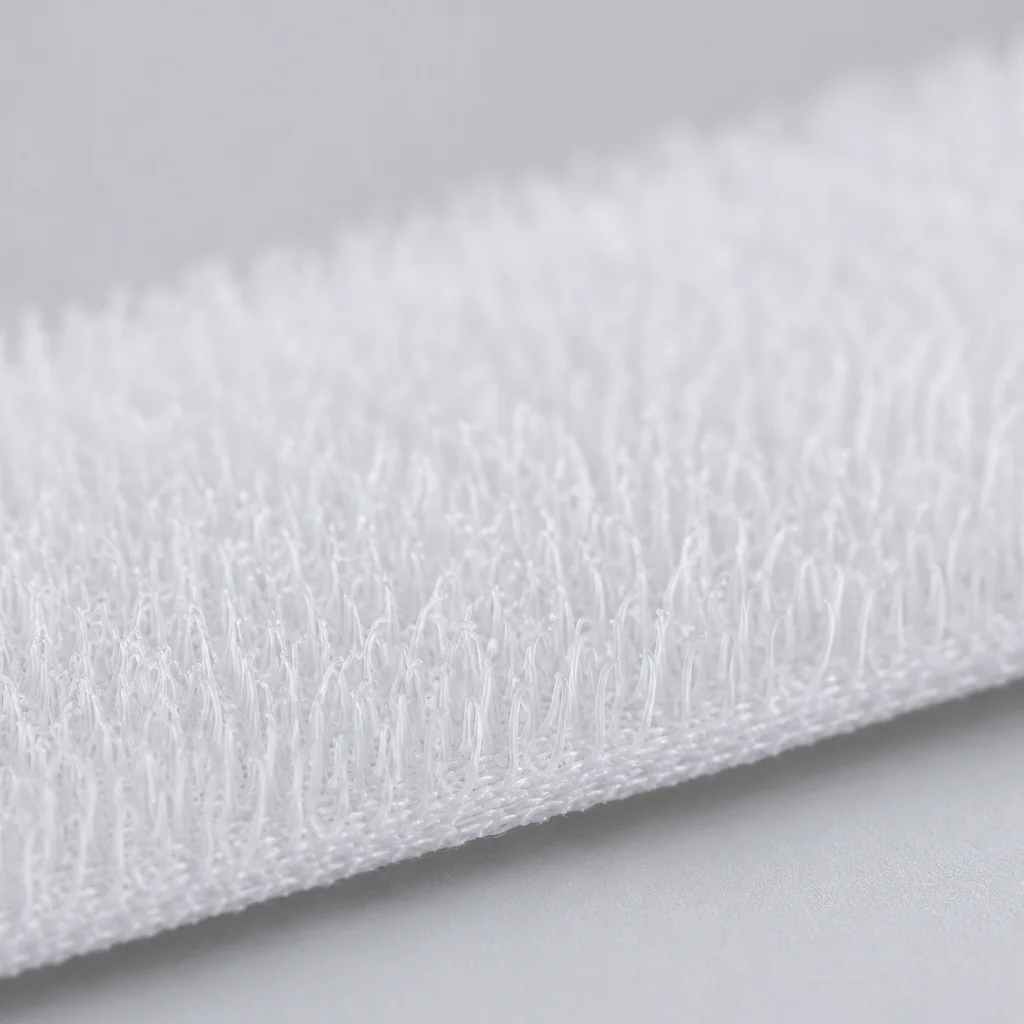
Scene illustration, not a customer project.
A workable clause has four parts, none of which requires a laboratory to start.
Bending behaviour. Either a measured stiffness value or a defined drape test, for example how a 25 mm wide strip hangs over a fixed edge. State the test method and the acceptance range.
Surface texture. Describe what the wearer should feel: no sharp points under light finger pressure, no scratch when drawn across the inner forearm. Ask for a reference sample to be signed and kept by both sides.
Edge treatment. Cut method (hot knife, die cut, laser), edge radius, and whether the edge is sealed. This is usually the real cause of complaints.
Thickness and weight. Overall thickness with tolerance, and backing weight in g/m². These two numbers predict drape and sewing behaviour better than any adjective.
The signed reference sample is the part most often skipped and the part that ends most arguments. A physical standard at both ends of the supply chain is worth more than three paragraphs of description.
Soft hooks fail differently from standard hooks. Instead of the hook breaking, the filament bends permanently and the hook "lays down", so engagement fades gradually rather than failing suddenly.
Wash cycles. Specify the cycle count, temperature, detergent type and drying method. Line drying and tumble drying produce very different results.
Lint and fibre. Soft hooks with fine filaments pick up fibre from fleece and towelling. A loop that sheds fibre will clog a fine hook faster than a standard one.
Cycle count in use. A wrist strap opened 20 times a day reaches 7,000 cycles in a year. State the expected service life so the supplier can choose density accordingly.
Five checks, all runnable on the customer's own components.
Blind hand-feel panel. Three to five people, samples unlabelled, ranked for comfort. Crude, but it catches products that fail the only test that matters.
Low-pressure engagement. Close the strap by hand, hang a defined load, and measure slip. Compare against roller-applied results.
Peel and shear at stated conditions. Record width, load, speed and dwell time. Values without conditions are marketing.
Wash or abrasion cycling. Measure holding after the agreed cycle count, not before.
Edge inspection. Look at the cut edge under magnification, and run it across the inner forearm.
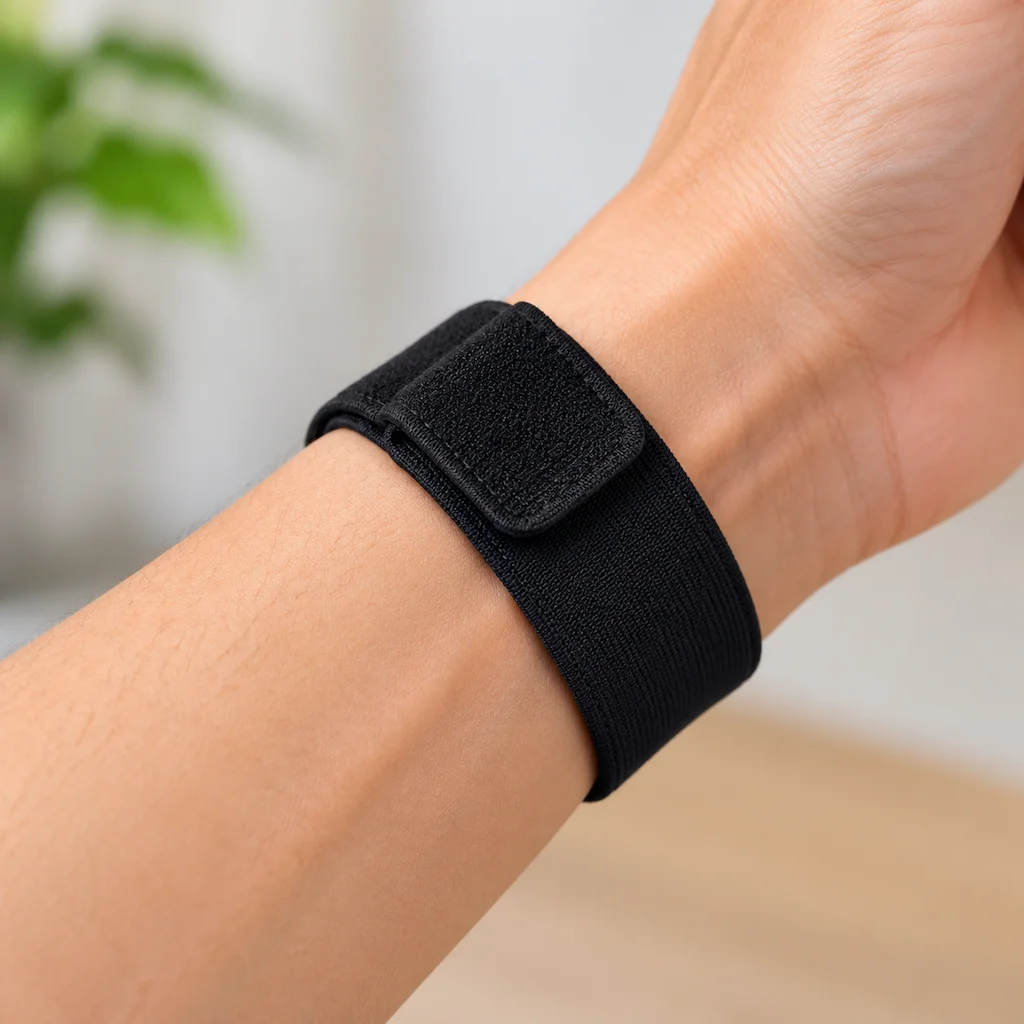
Scene illustration, not a customer project.
Four problems account for most wearable returns.
Soft face, sharp edge. The face was specified, the edge was not.
Soft hook on a stiff loop. The assembly feels hard although the hook passed its own test.
Density cut to hit a price. The sample felt right and held right; the production lot feels the same and holds less, because filament diameter dropped without a density increase.
Wash performance assumed. A product validated dry, sold for a washable garment.
A short brief prevents most of these: the body-contact area and duration, expected open-close cycles, wash method and count, target peel and shear with test conditions, edge requirement, thickness and backing weight limits, and whether a signed reference sample is held by both sides.
Softness is a legitimate specification. It only becomes unmanageable when it is left as an adjective. Once it is a signed sample plus four measurable parameters, a buyer can compare suppliers on equal terms and a supplier knows exactly what will be inspected.
Related reading: sterilization compatibility and adhesive-backed solutions.


