
Views: 1 Author: Site Editor Publish Time: 2026-11-19 Origin: Site


Most hook and loop disputes do not start with a defect. They start with a sentence: “this is not what we approved.” By the time that sentence is spoken, two hundred rolls are already packed, and the argument comes down to memory — whose sample, which photo, what the email actually said.
The gap is rarely dishonesty. It is that three things were never written down at the same time: the physical sample that was approved, the numerical specification that sample represents, and the test that proves a later batch still matches it. Without those three, every reorder becomes a negotiation instead of a check.
Golden sample. A physical reference, signed and dated, kept by both sides. It is the tie-breaker when words fail.
Spec sheet. The numbers behind the sample: width, thickness, hook density, peel and shear values, colour tolerance, adhesive type and coat weight, roll length and packing. It is what a new operator, a new machine or a new dye lot can actually be measured against.
Test baseline. The method and the pass line. Not “good peel strength”, but “peel per GB/T 23315 or ASTM D5170, this specimen width, this many samples, this minimum”.
One document alone always fails. A sample without numbers cannot be reproduced; numbers without a sample get argued about at the edges; both without a test method drift silently between batches.
Enough material to test, not just to look at. At least one metre of full-width tape, plus a piece of the mating surface. A 5 cm swatch cannot be mounted in a peel fixture.
Both halves. Hook and loop is a system. Approving a hook face against an arbitrary loop face locks nothing.
Identification. Article code, version, date, approver name, and the spec sheet revision it belongs to — written on the bag, not in an email.
Storage conditions. Sealed bag, out of sunlight, at ordinary room humidity. A sample that sat on a windowsill for a year is no longer a reference.
A stated validity. Most programmes re-confirm annually, or immediately after any material or process change.
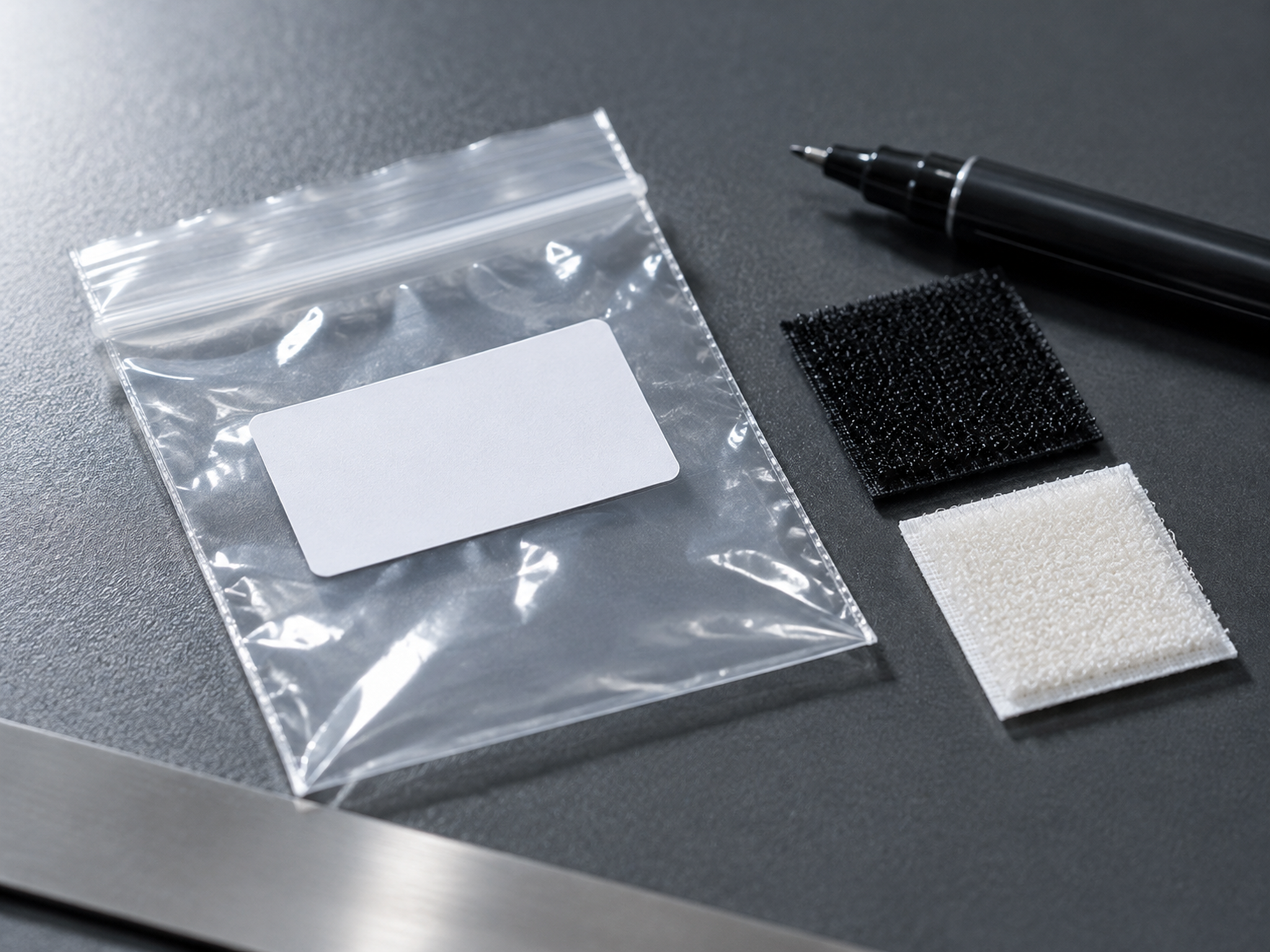
Illustrative scene, not a customer project photo.
Use the same three blocks every time, so nothing is silently dropped.
Construction. Yarn or moulded hook, hook density, loop type (napped, un-napped, brushed), backing (plain, adhesive, heat-seal), total thickness with tolerance, and the colour reference with its ΔE limit.
Performance. Peel strength and shear strength with method and specimen width; cycle life at a stated load; and for adhesive grades, initial tack, 180° peel on the actual mating surface, and service temperature range. A number without a method is not a specification.
Commercial and packing. Roll width tolerance, roll length, core size, splice policy, carton marks, and the sampling plan used for batch release.
Keep it to two pages. A specification nobody reads is worse than none, because it creates the illusion of control.
Agree four things and write them into the spec sheet:
Which tests are routine (every batch) and which are type tests (on change or annually).
Sample size and preparation — number of specimens, conditioning time, and the mating surface used.
Pass line — a minimum value, not an average, plus the allowed spread between specimens.
Who tests and who keeps records — supplier in-house, third party, or both, with the retention period.
For most industrial programmes, routine release is peel plus dimensional check plus visual; cycle life and temperature ageing are type tests. That split keeps cost sane without letting drift through.
Re-approval is cheap. Discovering the change in the field is not. Treat any of the following as a trigger:
Yarn supplier, resin grade or hook mould change
Adhesive type, coat weight or curing condition change
New dye lot outside the approved ΔE window
New slitting or die-cutting tooling, or a moved production line
Any packing change that alters compression or moisture exposure
When a trigger fires, the supplier submits a first-article sample against the existing spec sheet. If it passes, a new sample version is issued and both sides replace the old bag. If it fails, the change is not shipped — not “shipped with a note”.
Sample request → spec sheet drafted from the sample → both sides test the sample → golden sample sealed and signed → first article from the mass-production run checked against it → batch release against the sampling plan → annual re-confirmation.
The step most often skipped is the first article. It is also the cheapest place to catch a problem: one roll, before the run, rather than two hundred after it.
Approving a sample by photo. Colour and hand feel do not survive compression and white balance.
Recording peel strength without the specimen width. A wider strip reads higher and means nothing.
Letting the supplier keep the only signed sample.
Treating a passing batch as permission to skip the next first article.
Writing the spec sheet after the PO, so it describes what was made rather than what was bought.
Three questions expose whether a programme is actually locked: Can you send the signed golden sample back with the spec sheet revision number on the bag? Which tests run on every batch, and which only on change? What triggers a re-approval on your side? A supplier who answers all three without checking has a system. One who answers “we always keep quality stable” does not.


