
Views: 1 Author: Site Editor Publish Time: 2026-09-23 Origin: Site


On September 1, during CINTE26 in Shanghai, the 2026 Nonwoven High-Quality Development Conference opened under the theme "Reconstructing the Growth Paradigm." It was co-hosted by the China National Nonwovens & Industrial Textiles Association (CNTAC), the American Nonwovens Association (ANA), the China Council for the Promotion of International Trade’s textile branch (CCPIT Textiles), and Messe Frankfurt (HK), with support from the European nonwovens association (EDANA).
The conference released a batch of hard data worth any hook-and-loop buyer’s attention:
• 2025 Chinese nonwoven output: 9.207 million tons — a record high
• Chinese nonwoven exports: above US$12 billion
• North American nonwoven capacity: 5.747 million tons (US share: 88%)
• India nonwoven market, 2025–2031: CAGR 6.7% (US$2.588B → US$3.824B)
For the hook-and-loop industry, we read four signals from them.
Lingshen Li, Vice Chairman of the China Textile Industry Association and chair of the national industrial-textiles standards committee (SAC/TC606), gave the opening figures. He noted that the industry’s globalization is moving "from taking products abroad, to taking brands abroad, and taking capacity abroad" — and flagged three industrialization breakthroughs: electrospun nanofibers, flash-spun nonwovens, and flushable (water-dispersible) nonwovens.
A record 9.2 million-ton domestic output means the raw-material and manufacturing base for nonwoven-based fasteners — including the nonwoven hook face of hook-and-loop tape — is deep, competitive, and still scaling. For buyers, that is the foundation for stable pricing and fast sampling.
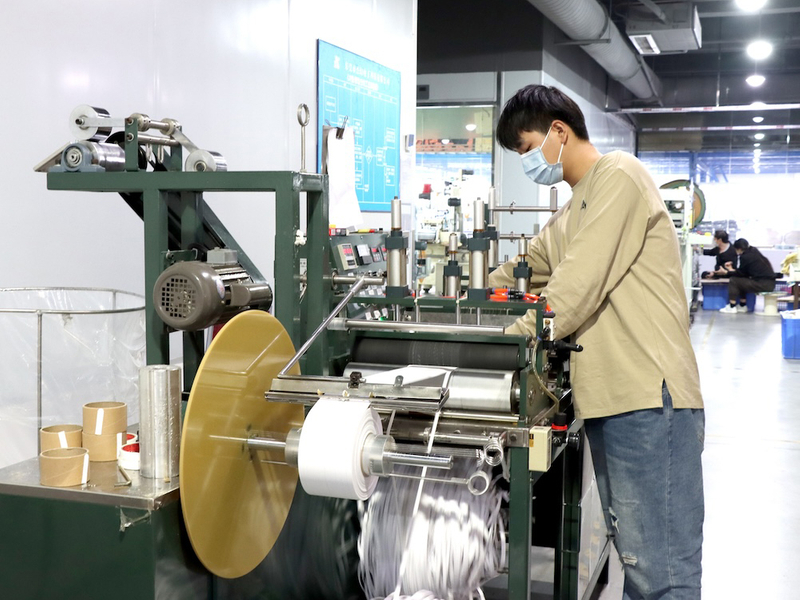
Adhesive slitting machine — Jiehuan production line.
The same opening speech named five structural challenges: imbalanced supply structure, "involution" (excessive) competition, insufficient fundamental research, technology-and-cost bottlenecks in high-end applications, and tariff barriers — plus five directions: innovation-driven, greening, digitalization, cross-application, and rational development.
The explicit mention of tariff barriers matters for procurement: origin diversification (China + Mexico + others) and contract-level price/lead-time protection are no longer "nice to have." Jiehuan supports buyers with multi-region supply discussion, custom specs, and sample lead-time commitments.
Guimei Li, chair of the CNTAC, set out the "15th Five-Year Plan" roadmap: three pillars (sci-tech innovation, green transition, digitalization), ten key common technologies, wider biodegradable-material use, and carbon-footprint verification, with AI integration across the value chain. Her advice to factories: be specialized, refined, differentiated, innovative; invest prudently; stay compliant.
Also released at the conference: the "Report on Fiber Content Disclosure for E-Commerce Personal-Care Wipes and the Development Trend of Biodegradability" (Sateri + Nonwovens Green Development Committee) — label transparency is becoming a market norm, not a bonus.
Translation for hook-and-loop: fire-retardant, antimicrobial, and other functional lines, plus biodegradable options and carbon-footprint documentation, are where the next procurement requirements will land.
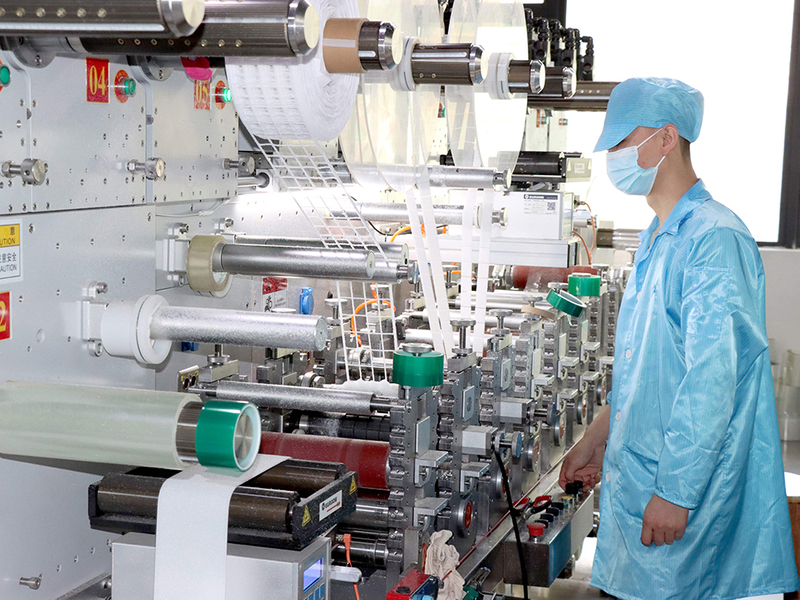
Rotary die cutting machine — Jiehuan production line.
Tony Fragnito (video address, ANA): total North American nonwoven capacity is 5.747 million tons, with the US holding 88% — and capacity is moving toward Mexico and Central/South America. Absorbent hygiene and filtration are the largest end markets; wet wipes are the fastest-growing. He was blunt: global overcapacity is the industry’s core challenge, pushing suppliers toward sustainable and specialized markets.
India’s nonwoven market is projected at a 6.7% CAGR through 2031 (US$2.588B → US$3.824B).
For buyers: the two big growth pockets (North America and India) are reshaping where capacity — and therefore price power — sits. Sourcing strategy should be region-aware.
Zhang Deyuan (circular-economy expert, National Development and Reform Commission) added the regulatory vector: a full-chain circular-economy system by 2030, with wet wipes following a "reduce plastic at source — manage in process — handle at end" path.
1. Lock cost logic, not just price: with record Chinese output and named tariff risk, negotiate price-band + spec lock-in, and keep a second-region option warm;
2. Put green requirements into RFQs: carbon-footprint documentation and biodegradable options are the 15th-Plan direction — early asks build supplier readiness;
3. Match regions to applications: North America (capacity shift to Mexico) and India (6.7% CAGR) are where volume and price will move next.
Jiehuan (Dongguan Jiehuan Electronic Technology Co., Ltd.) tracks the 15th-Plan direction and GB/T 23315-2026 implementation, and supports hook-and-loop R&D, customization and testing. Contact Jiehuan for samples and specifications.
References
Texleader (China National Textile Information Center): "Gathering global wisdom, reconstructing growth paradigms — 2026 Nonwoven High-Quality Development Conference opens in Shanghai", 2026-09-06 https://www.texleader.com.cn/article-35707.html


